Industry packs

Logistics and supply chain industry pack

Synthetic shipment, parcel, tracking, customs and freight test data with linked masking

Preview only · not activatable yet Version 1.0.0 · Complete

Everything on this page works without an account. Prefer a conversation? Request a demo (optional). Missing something? Request a feature.

This pack is installed and passes DataNivra’s pack conformance kit through the real engine, but it cannot be activated yet: no plan includes it yet, the standard agent image does not ship it, the control-plane catalogue does not list it and the hosted sandbox has no synthetic estate for it. You can explore its synthetic records, masking and scenarios on this page and in the browser demo. Tell us if you need it: demand decides which packs become activatable next.

Problems this pack solves

Masked data that still joins across 5 systems

7 cross-system relationships link billing, carrier, customs, tms and wms; the pack's masking keeps one pseudonym per identity on every side. For example, tms.shippers.shipper_id and billing.freight_invoices.shipper_ref get the same pseudonym.

The cases production samples rarely contain

9 ready-made scenarios generate them on demand, for example: international shipments whose customs declarations are held or inspected, with a reason; failed delivery attempts and refusals at the door, without a signature; undeliverable shipments returned to the shipper and booked back into the warehouse.

Sensitive fields found and masked before anyone sees them

43 columns across 13 entities are classified (direct identifier, financial, PII, quasi identifier and sensitive) and covered by 3 masking templates you review and approve.

Evidence that each dataset is fit to use

2 certification presets check masking coverage, referential integrity, orphans and row counts before a dataset can be provisioned; a failed dataset is never provisioned.

Entities and relationships

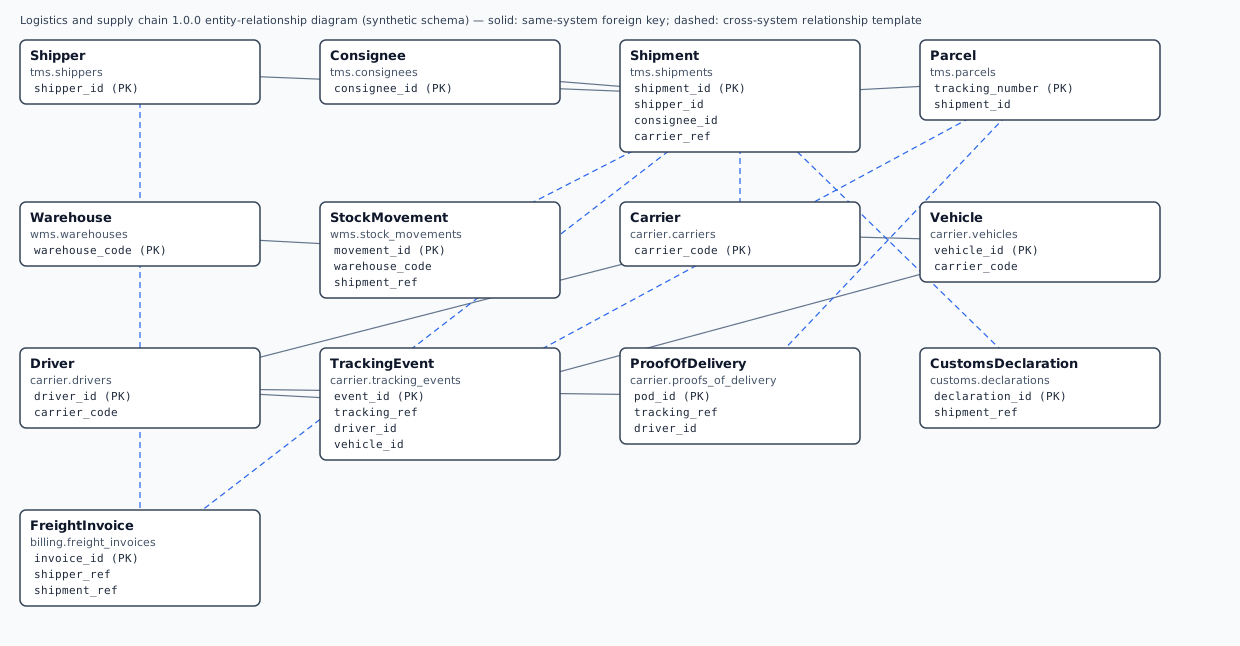
13 entities across 5 source systems, generated from the pack’s own entity model.

Entity graph of the Logistics and supply chain pack13 entities in 5 systems (tms, wms, carrier, customs, billing) linked by 16 relationships, 7 of them across systems. The table after the graph lists every relationship.tmswmscarriercustomsbillingShipper (tms.shippers)Shippertms.shippersConsignee (tms.consignees)Consigneetms.consigneesShipment (tms.shipments)Shipmenttms.shipmentsParcel (tms.parcels)Parceltms.parcelsWarehouse (wms.warehouses)Warehousewms.warehousesStockMovement (wms.stock_movements)StockMovementwms.stock_movementsCarrier (carrier.carriers)Carriercarrier.carriersVehicle (carrier.vehicles)Vehiclecarrier.vehiclesDriver (carrier.drivers)Drivercarrier.driversTrackingEvent (carrier.tracking_events)TrackingEventcarrier.tracking_eventsProofOfDelivery (carrier.proofs_of_delivery)ProofOfDeliverycarrier.proofs_of_deli…CustomsDeclaration (customs.declarations)CustomsDeclarationcustoms.declarationsFreightInvoice (billing.freight_invoices)FreightInvoicebilling.freight_invoic…
Arrows point from the referencing entity to the one it references. Solid: a foreign key inside one system. Dashed: a cross-system relationship — the pack keeps the same pseudonym on both sides, so masked data still joins.
All 16 relationships as a table
Relationships of the Logistics and supply chain pack
EntityReferencesColumnsKind
ShipmentShippershipper_id → shipper_idWithin a system
ShipmentConsigneeconsignee_id → consignee_idWithin a system
ParcelShipmentshipment_id → shipment_idWithin a system
StockMovementWarehousewarehouse_code → warehouse_codeWithin a system
VehicleCarriercarrier_code → carrier_codeWithin a system
DriverCarriercarrier_code → carrier_codeWithin a system
TrackingEventDriverdriver_id → driver_idWithin a system
TrackingEventVehiclevehicle_id → vehicle_idWithin a system
ProofOfDeliveryDriverdriver_id → driver_idWithin a system
ShipmentCarriercarrier_ref → carrier_codeAcross systems (pack relationship template)
StockMovementShipmentshipment_ref → shipment_idAcross systems (pack relationship template)
TrackingEventParceltracking_ref → tracking_numberAcross systems (pack relationship template)
ProofOfDeliveryParceltracking_ref → tracking_numberAcross systems (pack relationship template)
CustomsDeclarationShipmentshipment_ref → shipment_idAcross systems (pack relationship template)
FreightInvoiceShippershipper_ref → shipper_idAcross systems (pack relationship template)
FreightInvoiceShipmentshipment_ref → shipment_idAcross systems (pack relationship template)

Realistic synthetic records

Synthetic data. Every record on this page is synthetic, generated from a fixed seed by the pack's own generator; masked values come from the real masking engine.

Shipper — tms.shippers (synthetic)
shipper_id sensitivecompany_namecontact_name sensitivecontact_email sensitivecontact_phone sensitivetax_id sensitivecountry_codeaccount_tier
SHP00000001Ivervane TradingIro Morby—555-063-4648VAT-ZZ-57908886ZZSTANDARD
SHP00000002Ashford TradingJoan Dunmerejoan.pemford9160@example.net555-060-0991VAT-ZZ-95585808ZZPREFERRED

Masking: before and after

Template Linked logistics test data (LOG_LINKED_TEST_DATA) applied to a synthetic Shipper record from tms.shippers.

Synthetic Shipper record before and after masking
ColumnClassified asBefore (synthetic)After masking
shipper_idDirect identifierSHP00000001SHP16473359
contact_namePII, Direct identifierIro MorbyOrel Langridge
contact_emailPII, Direct identifier—— (same value after masking)
contact_phonePII, Direct identifier555-063-4648555-033-2654
tax_idPII, Direct identifierVAT-ZZ-57908886IZP-OJ-26647919

Same pseudonym in two systems. The identifier SHP00000001 appears in tms.shippers.shipper_id and in billing.freight_invoices.shipper_ref. Both become SHP16473359, so the masked systems still join (relationship LOG_INVOICE_SHIPPER).

Masked with a fixed public sample key so this example is reproducible; your data is masked with your own key, referenced from your secret store.

Synthetic scenarios you can run

11 runnable scenarios. Preview them in your browser without an account; the hosted sandbox opens when the pack becomes activatable.

Everyday parcels

Normal LOG_EVERYDAY_PARCELS

Ordinary shippers, consignees, shipments, parcels, warehouse movements, scans and invoices

Everyday, valid records: the baseline most tests expect. Children per parent record: 1–3.

Preview in the browser demo: Everyday parcels

Customs holds

Rare LOG_CUSTOMS_HOLDS

International shipments whose customs declarations are held or inspected, with a reason

Valid but uncommon business situations that production samples often miss. Children per parent record: 1–2.

Preview in the browser demo: Customs holds

Failed deliveries

Rare LOG_FAILED_DELIVERIES

Failed delivery attempts and refusals at the door, without a signature

Valid but uncommon business situations that production samples often miss. Children per parent record: 1–3.

Preview in the browser demo: Failed deliveries

Returns to sender

Rare LOG_RETURNS_TO_SENDER

Undeliverable shipments returned to the shipper and booked back into the warehouse

Valid but uncommon business situations that production samples often miss. Children per parent record: 1–2.

Preview in the browser demo: Returns to sender

Lost parcels

Rare LOG_LOST_PARCELS

Shipments lost in the network after a hub scan; their invoices are disputed

Valid but uncommon business situations that production samples often miss. Children per parent record: 1–2.

Preview in the browser demo: Lost parcels

Hazmat parcels

Rare LOG_HAZMAT_PARCELS

Dangerous-goods parcels carrying an invented hazard class, never on same-day service

Valid but uncommon business situations that production samples often miss. Children per parent record: 1–3.

Preview in the browser demo: Hazmat parcels

Peak season surge

Rare LOG_PEAK_SEASON_SURGE

A burst of carrier scans and deliveries within three peak-season days

Valid but uncommon business situations that production samples often miss. Children per parent record: 3–8.

Preview in the browser demo: Peak season surge

Heavy parcel threshold

Boundary LOG_HEAVY_PARCEL_THRESHOLD

Parcel weights exactly at the two-person handling limit or ten grams either side of it

Values at the edges of valid ranges (limits, thresholds, extremes). Children per parent record: 1–3.

Preview in the browser demo: Heavy parcel threshold

Sla cutoff deliveries

Boundary LOG_SLA_CUTOFF_DELIVERIES

Deliveries exactly at the promised time or one minute either side of it

Values at the edges of valid ranges (limits, thresholds, extremes). Children per parent record: 1–2.

Preview in the browser demo: Sla cutoff deliveries

Duplicate scans

Duplicate LOG_DUPLICATE_SCANS

Carrier scans delivered twice by an integration with identical content under new ids

Records that repeat others under new keys (clean-up and matching tests). Children per parent record: 2–5.

Preview in the browser demo: Duplicate scans

Shipment histories

Historical LOG_SHIPMENT_HISTORIES

Multi-year, referentially intact shipment, tracking, customs and billing histories

Old records for archive, migration and retention tests. Children per parent record: 2–4.

Preview in the browser demo: Shipment histories
Negative tests, kept apart. This scenario produces deliberately broken data for error handling and never passes certification as valid data:

  • LOG_BROKEN_REFERENCES — Dangling cross-system references and invalid values for error-handling tests

Sample schemas and representative outputs

The schema the pack expects in each system (also as CREATE TABLE DDL in the downloads). A run produces a masked or synthetic dataset with the same tables, a certification report with the gates of the chosen preset, and an evidence manifest with checksums — the rows stay in your environment.

Shipper — tms.shippers · 8 columns

A shipper account (the natural subset root): a business or sole trader sending goods.

ColumnTypeRequiredSensitive classes
shipper_id (key)VARCHAR(12)YesDirect identifier
company_nameVARCHAR(64)Yes—
contact_nameVARCHAR(128)YesPII, Direct identifier
contact_emailVARCHAR(128)NoPII, Direct identifier
contact_phoneVARCHAR(32)NoPII, Direct identifier
tax_idVARCHAR(20)NoPII, Direct identifier
country_codeVARCHAR(2)Yes—
account_tierVARCHAR(12)Yes—
Consignee — tms.consignees · 10 columns

The person or business a shipment is delivered to.

ColumnTypeRequiredSensitive classes
consignee_id (key)BIGINTYes—
full_nameVARCHAR(128)YesPII, Direct identifier
emailVARCHAR(128)NoPII, Direct identifier
phoneVARCHAR(32)NoPII, Direct identifier
street_addressVARCHAR(128)YesPII, Quasi identifier
cityVARCHAR(64)YesQuasi identifier
postal_codeVARCHAR(10)NoPII, Quasi identifier
country_codeVARCHAR(2)Yes—
delivery_instructionsVARCHAR(300)NoSensitive
is_businessBOOLEANYes—
Shipment — tms.shipments · 12 columns

A booked consignment from a shipper to a consignee, handed to one carrier.

ColumnTypeRequiredSensitive classes
shipment_id (key)VARCHAR(14)YesDirect identifier
shipper_idVARCHAR(12)YesDirect identifier
consignee_idBIGINTYes—
carrier_refVARCHAR(8)Yes—
service_levelVARCHAR(10)Yes—
payment_termsVARCHAR(14)Yes—
declared_valueDECIMAL(12,2)YesFinancial
is_internationalBOOLEANYes—
created_atTIMESTAMPYes—
promised_byTIMESTAMPYes—
actual_delivery_atTIMESTAMPNo—
statusVARCHAR(10)Yes—
Parcel — tms.parcels · 8 columns

One labelled piece of a shipment, identified by its tracking number.

ColumnTypeRequiredSensitive classes
tracking_number (key)VARCHAR(16)YesDirect identifier
shipment_idVARCHAR(14)YesDirect identifier
weight_kgDECIMAL(7,2)Yes—
length_cmINTYes—
width_cmINTYes—
height_cmINTYes—
is_hazmatBOOLEANYes—
hazmat_classVARCHAR(8)No—
Warehouse — wms.warehouses · 4 columns

A fulfilment warehouse (a facility, not a person).

ColumnTypeRequiredSensitive classes
warehouse_code (key)VARCHAR(8)Yes—
region_codeVARCHAR(8)Yes—
capacity_palletsINTYes—
is_bondedBOOLEANYes—
StockMovement — wms.stock_movements · 8 columns

A warehouse movement (inbound, pick, pack, outbound, return) for a shipment.

ColumnTypeRequiredSensitive classes
movement_id (key)BIGINTYes—
warehouse_codeVARCHAR(8)Yes—
shipment_refVARCHAR(14)YesDirect identifier
skuVARCHAR(16)Yes—
quantityINTYes—
movement_typeVARCHAR(10)Yes—
bin_locationVARCHAR(12)Yes—
moved_atTIMESTAMPYes—
Carrier — carrier.carriers · 4 columns

A road or air carrier (an organisation; its code is an unmasked business key).

ColumnTypeRequiredSensitive classes
carrier_code (key)VARCHAR(8)Yes—
nameVARCHAR(64)Yes—
modeVARCHAR(6)Yes—
is_subcontractorBOOLEANYes—
Vehicle — carrier.vehicles · 5 columns

A delivery vehicle; its plate links a driver and a route to a place and time.

ColumnTypeRequiredSensitive classes
vehicle_id (key)BIGINTYes—
carrier_codeVARCHAR(8)Yes—
registration_plateVARCHAR(12)YesDirect identifier
vehicle_typeVARCHAR(10)Yes—
capacity_kgINTYes—
Driver — carrier.drivers · 7 columns

A delivery driver (employee or contractor).

ColumnTypeRequiredSensitive classes
driver_id (key)VARCHAR(10)YesDirect identifier
carrier_codeVARCHAR(8)Yes—
full_nameVARCHAR(128)YesPII, Direct identifier
phoneVARCHAR(32)NoPII, Direct identifier
licence_numberVARCHAR(16)NoPII, Direct identifier
birth_dateDATENoPII, Quasi identifier
employment_typeVARCHAR(10)Yes—
TrackingEvent — carrier.tracking_events · 8 columns

A scan of a parcel (location-like: where and when the parcel — and its consignee — was).

ColumnTypeRequiredSensitive classes
event_id (key)BIGINTYes—
tracking_refVARCHAR(16)YesDirect identifier
event_codeVARCHAR(20)Yes—
occurred_atTIMESTAMPYesQuasi identifier
grid_cellVARCHAR(10)YesQuasi identifier
hub_codeVARCHAR(8)No—
driver_idVARCHAR(10)NoDirect identifier
vehicle_idBIGINTNo—
ProofOfDelivery — carrier.proofs_of_delivery · 9 columns

The outcome of a delivery attempt with recipient, signature and photo references.

ColumnTypeRequiredSensitive classes
pod_id (key)BIGINTYes—
tracking_refVARCHAR(16)YesDirect identifier
driver_idVARCHAR(10)YesDirect identifier
delivered_atTIMESTAMPYesQuasi identifier
outcomeVARCHAR(20)Yes—
recipient_nameVARCHAR(128)NoPII, Direct identifier
signature_refVARCHAR(24)NoDirect identifier
photo_refVARCHAR(24)NoDirect identifier
grid_cellVARCHAR(10)YesQuasi identifier
CustomsDeclaration — customs.declarations · 9 columns

An export/import declaration of an international shipment.

ColumnTypeRequiredSensitive classes
declaration_id (key)BIGINTYes—
shipment_refVARCHAR(14)YesDirect identifier
declarant_tax_idVARCHAR(20)NoPII, Direct identifier
commodity_codeVARCHAR(10)Yes—
declared_valueDECIMAL(12,2)YesFinancial
origin_countryVARCHAR(2)Yes—
statusVARCHAR(10)Yes—
hold_reasonVARCHAR(20)No—
lodged_atTIMESTAMPYes—
FreightInvoice — billing.freight_invoices · 9 columns

A freight charge invoiced to the shipper for one shipment.

ColumnTypeRequiredSensitive classes
invoice_id (key)BIGINTYes—
shipper_refVARCHAR(12)YesDirect identifier
shipment_refVARCHAR(14)YesDirect identifier
amountDECIMAL(10,2)YesFinancial
currencyVARCHAR(3)Yes—
issued_onDATEYes—
statusVARCHAR(10)Yes—
payer_ibanVARCHAR(34)NoFinancial, Direct identifier
payment_referenceVARCHAR(20)NoFinancial, Direct identifier

Compatible connectors

Verified with this pack version: PostgreSQL and Local files (Parquet / CSV). 17 more connectors are compatible by capability: they support what the pack needs, but have not been verified with this pack yet.

ConnectorStatus with Logistics and supply chain
Local files (Parquet / CSV)Verified with this pack
PostgreSQLVerified with this pack
Amazon S3 / S3-compatible storageCompatible by capability (not yet verified with this pack)
Apache Kafka (connector in preview)Compatible by capability (not yet verified with this pack)
Azure Blob Storage / Data Lake StorageCompatible by capability (not yet verified with this pack)
DatabricksCompatible by capability (not yet verified with this pack)
Generic SQL (SQLAlchemy)Compatible by capability (not yet verified with this pack)
Google BigQueryCompatible by capability (not yet verified with this pack)
HTTP APIs (connector in preview)Compatible by capability (not yet verified with this pack)
IBM Db2 (connector in preview)Compatible by capability (not yet verified with this pack)
Mainframe files (EBCDIC / copybook) (connector in preview)Compatible by capability (not yet verified with this pack)
MariaDBCompatible by capability (not yet verified with this pack)
Microsoft SQL ServerCompatible by capability (not yet verified with this pack)
MongoDB (connector in preview)Compatible by capability (not yet verified with this pack)
MySQLCompatible by capability (not yet verified with this pack)
Oracle DatabaseCompatible by capability (not yet verified with this pack)
Parquet filesCompatible by capability (not yet verified with this pack)
SnowflakeCompatible by capability (not yet verified with this pack)
SQLite (developer evaluation) (connector in preview)Compatible by capability (not yet verified with this pack)

Prerequisites and expected setup effort

You need

  • This pack is not in any plan yet.
  • One DataNivra agent inside your network (outbound HTTPS only) that ships Logistics and supply chain 1.0.0.
  • Read-only access to a compatible source (verified with this pack: PostgreSQL, Local files (Parquet / CSV)).
  • A non-production target environment the agent may write test data to.
  • A masking key in your own secret store, referenced as vault://…, azure-kv://… or env://… (DataNivra only ever sees the reference).
  • For production sources, a second person who approves policies (separation of duties).

A DataNivra agent that reports its installed industry packs (releases after agent 0.3.0); the control plane runs a pack job only on an agent holding the exact active pack version with the catalogued integrity digest.

Expected setup effort (estimates)

StepEstimate
Try the synthetic sandbox
No install: sign up and open the sandbox.
Minutes (estimate)
Install (or reuse) the agent
One Docker command or a Helm chart; outbound HTTPS only.
Under an hour (estimate)
Connect a source
Register a read-only source through the existing connector workflow.
Under an hour (estimate)
Review and approve policies
Create drafts from the Logistics and supply chain templates, review and approve them.
Under an hour (estimate)
First certified dataset
Run the first job; certification and evidence are produced automatically.
Minutes (estimate)

Certification presets in plain language

LOG_STRICT

Every gate; full masking coverage; zero orphaned shipments, parcels, warehouse movements, scans, proofs of delivery, declarations or invoices; exact row counts. Default for masked logistics test data.

  • Masking coverage of at least 100% of sensitive columns
  • No orphaned child records
  • Empty-value ratio may rise by at most 5%
  • Row counts must match exactly
16 gates it requires
  • POLICY_COVERAGE: every sensitive column is covered by an approved policy
  • MASKING_COMPLETION: masking finished on every covered column
  • REFERENTIAL_INTEGRITY: every reference still points at an existing record
  • SCHEMA_VALIDATION: the output schema matches the source schema
  • DATA_QUALITY: empty-value ratios stay within the preset’s drift limit
  • ROW_COUNT_RECONCILIATION: row counts match the plan within the tolerance
  • ORPHAN_DETECTION: no child record lost its parent
  • PROVENANCE: every row is tagged masked or synthetic
  • MANIFEST: a manifest lists every output table with checksums
  • POLICY_VERSION: the exact approved policy versions are recorded
  • ENGINE_VERSION: the engine version is recorded
  • CHECKSUMS: output checksums are recorded for later verification
  • IDENTITY_CONSISTENCY: linked identifiers got the same pseudonym in every system
  • SOURCE_READ_ONLY: the source was only read, never written
  • EGRESS_GUARD: no row-level data left the agent
  • CONNECTOR_HEALTH: the connectors stayed healthy during the run

LOG_SCENARIO_TESTING

Every gate, with slightly relaxed NULL-ratio drift for scenario datasets whose business states (undelivered shipments, failed attempts without signatures, cleared declarations without a hold reason) leave optional fields empty.

  • Masking coverage of at least 100% of sensitive columns
  • No orphaned child records
  • Empty-value ratio may rise by at most 15%
  • Row counts must match exactly
16 gates it requires
  • POLICY_COVERAGE: every sensitive column is covered by an approved policy
  • MASKING_COMPLETION: masking finished on every covered column
  • REFERENTIAL_INTEGRITY: every reference still points at an existing record
  • SCHEMA_VALIDATION: the output schema matches the source schema
  • DATA_QUALITY: empty-value ratios stay within the preset’s drift limit
  • ROW_COUNT_RECONCILIATION: row counts match the plan within the tolerance
  • ORPHAN_DETECTION: no child record lost its parent
  • PROVENANCE: every row is tagged masked or synthetic
  • MANIFEST: a manifest lists every output table with checksums
  • POLICY_VERSION: the exact approved policy versions are recorded
  • ENGINE_VERSION: the engine version is recorded
  • CHECKSUMS: output checksums are recorded for later verification
  • IDENTITY_CONSISTENCY: linked identifiers got the same pseudonym in every system
  • SOURCE_READ_ONLY: the source was only read, never written
  • EGRESS_GUARD: no row-level data left the agent
  • CONNECTOR_HEALTH: the connectors stayed healthy during the run

Activation status

What is missing before you can activate the Logistics and supply chain pack yourself:

  • no plan includes it yet
  • the standard agent image does not ship it
  • the control-plane catalogue does not list it
  • the hosted sandbox has no synthetic estate for it

Until then, preview it in the browser demo and download its synthetic asset bundle below.

Tell us you need the Logistics and supply chain pack or request a feature for it.

Downloads

Version 1.0.0, 71 files (272.1 KB), all synthetic and generated from the pack itself. Every file’s SHA-256 is listed in MANIFEST.json.

Start here (2)
Entity–relationship diagram (2)
Sample schemas (6)
Policy templates (9)
API, CLI, SDK and CI/CD examples (10)
Synthetic sample data (CSV, JSON, Parquet) (40)

Troubleshooting

The reason codes you can meet on the way, with the recovery step. Every code is also in the error-code catalog.

SANDBOX_PACK_NOT_OFFERED — Synthetic estate not offered
A requested synthetic estate (industry pack) is not available in the hosted sandbox. What to do: Start the sandbox with the default estates.
ENTITLEMENT_REQUIRED — Plan does not include this
Your plan does not include this feature or industry pack. What to do: Upgrade in Billing & Plan.
PACK_INTEGRITY_UNVERIFIED — Pack integrity not verified
This pack version was registered without an integrity digest, so it cannot be activated (fail closed). What to do: Ask your operator to re-register the pack catalogue with the current control-plane image (register-pack), then activate again.
PACK_DEPENDENCY_INACTIVE — Required pack not active
This pack depends on another industry pack that is not active for your organization. What to do: Activate the packs this pack depends on first, then activate it again.
AGENT_PACK_MISSING — No agent can run this industry pack
The job's agent does not report the pack (older agents report no packs at all), so the job was not sent. What to do: Upgrade the agent to a release that reports its installed packs and ships this pack, then run the request again.
AGENT_PACK_VERSION_INCOMPATIBLE — Industry pack version differs on the agent
The agent holds a different version of the pack than the one the job was approved for. What to do: Deploy an agent with the pack's active version, or roll the pack back in Industry packs.
AGENT_PACK_INTEGRITY_MISMATCH — Agent pack differs from the catalogue
The agent reports the pack's version with a different integrity digest than the catalogued one, so the job was not sent. What to do: Redeploy the agent from the official signed image for this release, then run the request again.
PACK_TEMPLATES_UNAVAILABLE — Pack templates not registered
This pack version was registered without its policy templates. What to do: Ask your operator to re-register the pack catalogue (register-pack); create policies manually meanwhile.
PACK_TEMPLATE_KEY_REF_REQUIRED — Masking key reference required
A selected template keeps identities linked across systems and needs your masking key reference. What to do: Provide key_ref, e.g. vault://your-vault/tdm-masking-key, then create the drafts again.
PACK_NOT_ENABLED — Industry pack not enabled
The industry pack is not enabled for this tenant. What to do: Enable the pack (if your plan includes it).

Frequently asked questions

Are the Logistics and supply chain records on this page real?
No. Every record on this page is synthetic, generated from a fixed seed by the pack's own generator; masked values come from the real masking engine. The masking example uses a fixed public sample key; your own data is masked with a key from your secret store.
Can I activate the Logistics and supply chain pack myself?
This pack is installed and passes DataNivra’s pack conformance kit through the real engine, but it cannot be activated yet: no plan includes it yet, the standard agent image does not ship it, the control-plane catalogue does not list it and the hosted sandbox has no synthetic estate for it. You can explore its synthetic records, masking and scenarios on this page and in the browser demo. Tell us if you need it: demand decides which packs become activatable next.
Which databases and files does the Logistics and supply chain pack work with?
Verified with this pack version: PostgreSQL and Local files (Parquet / CSV). 17 more connectors are compatible by capability: they support what the pack needs, but have not been verified with this pack yet.
How long does a first certified Logistics and supply chain dataset take?
Estimates, not guarantees — try the synthetic sandbox: minutes; install (or reuse) the agent: under an hour; connect a source: under an hour; review and approve policies: under an hour; first certified dataset: minutes.
Which test scenarios does the Logistics and supply chain pack include?
11 runnable scenarios (everyday parcels, customs holds, failed deliveries, returns to sender and more), plus 1 negative-test scenario kept apart from valid data.
Do Logistics and supply chain rows leave my network?
No. The DataNivra agent runs inside your environment: it reads the source, masks, subsets, generates and certifies there, and sends only metadata, aggregate counts and evidence to the DataNivra control plane (customer-resident processing, zero raw-production-data egress).

Learn the concepts, then come back to activate

Regulatory context

The Logistics and supply chain pack covers data that laws and industry rules often treat as sensitive. It supports your privacy and governance programmes by keeping those records inside your environment and producing certification evidence; it does not, by itself, make any system or organisation compliant with any law, regulation or standard.

Everything on this page works without an account. Prefer a conversation? Request a demo (optional). Missing something? Request a feature.