Industry packs

General Enterprise industry pack

Customer, order and support test data that matches across CRM, ERP and support.

Customers, orders, products, suppliers, employees, contracts, invoices and payments

Fully self-service (journey proven end to end) Version 2.0.0 · Available in paid plans

The full General Enterprise 2.0.0 journey — from the public pack page through the synthetic sandbox, signup, activation, agent and source setup, scenario, masking and subsetting, certification and provisioning to evidence export — was verified end to end on a local real-component stack (the real control plane, agent, engine, sandbox runner, website and console built from source, with synthetic data) on 2026-10-09. Published agents 0.4.4, 0.4.3, 0.4.2, 0.4.1 and 0.4.0 run this pack version.

No call and no credit card needed. Prefer a conversation? Request a demo (optional). Missing something? Request a feature.

An engineer in safety glasses assembling electronics on a factory line

Included in Free Trial, Developer, Team, Business, Enterprise and Private Cloud / Self-Hosted. You can activate it for your organization yourself in the console; no call is needed.

Problems this pack solves

Masked data that still joins across 5 systems

6 cross-system relationships link commerce, crm, finance, hr and procurement; the pack's masking keeps one pseudonym per identity on every side. For example, crm.customers.customer_id and commerce.orders.customer_ref get the same pseudonym.

The cases production samples rarely contain

6 ready-made scenarios generate them on demand, for example: out-of-stock products and back-ordered lines awaiting replenishment; cancelled and returned orders with matching line statuses and refunds; shipments or go-lives that missed the promised date by one to eight weeks.

Sensitive fields found and masked before anyone sees them

35 columns across 10 entities are classified (direct identifier, financial, PII, quasi identifier and sensitive) and covered by 3 masking templates you review and approve.

Evidence that each dataset is fit to use

3 certification presets check masking coverage, referential integrity, orphans and row counts before a dataset can be provisioned; a failed dataset is never provisioned.

Entities and relationships

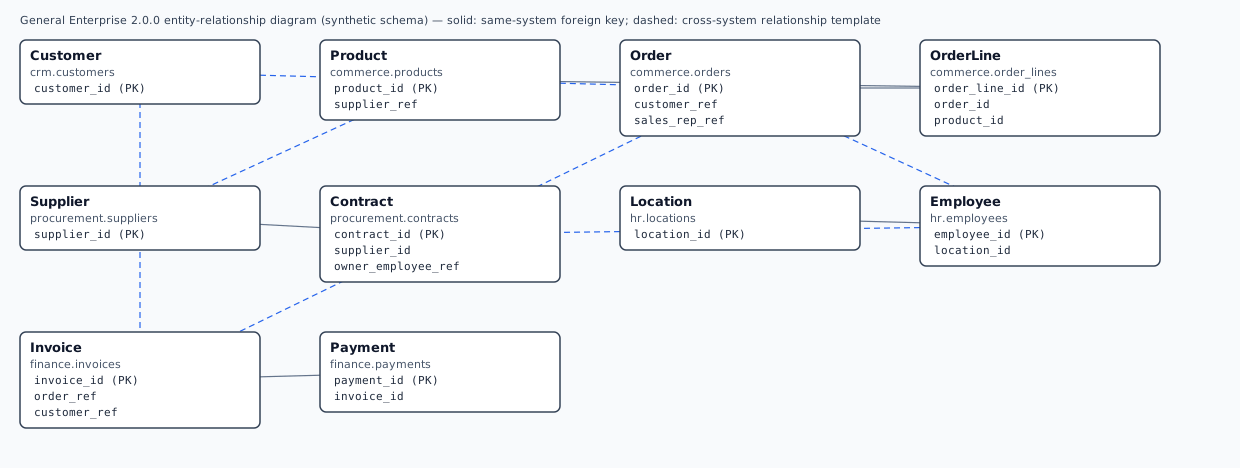
10 entities across 5 source systems, generated from the pack’s own entity model.

Entity graph of the General Enterprise pack10 entities in 5 systems (crm, commerce, procurement, hr, finance) linked by 11 relationships, 6 of them across systems. The table after the graph lists every relationship.crmcommerceprocurementhrfinanceCustomer (crm.customers)Customercrm.customersProduct (commerce.products)Productcommerce.productsOrder (commerce.orders)Ordercommerce.ordersOrderLine (commerce.order_lines)OrderLinecommerce.order_linesSupplier (procurement.suppliers)Supplierprocurement.suppliersContract (procurement.contracts)Contractprocurement.contractsLocation (hr.locations)Locationhr.locationsEmployee (hr.employees)Employeehr.employeesInvoice (finance.invoices)Invoicefinance.invoicesPayment (finance.payments)Paymentfinance.payments
Arrows point from the referencing entity to the one it references. Solid: a foreign key inside one system. Dashed: a cross-system relationship — the pack keeps the same pseudonym on both sides, so masked data still joins.
All 11 relationships as a table
Relationships of the General Enterprise pack
EntityReferencesColumnsKind
OrderLineOrderorder_id → order_idWithin a system
OrderLineProductproduct_id → product_idWithin a system
ContractSuppliersupplier_id → supplier_idWithin a system
EmployeeLocationlocation_id → location_idWithin a system
PaymentInvoiceinvoice_id → invoice_idWithin a system
OrderCustomercustomer_ref → customer_idAcross systems (pack relationship template)
OrderEmployeesales_rep_ref → employee_idAcross systems (pack relationship template)
ProductSuppliersupplier_ref → supplier_idAcross systems (pack relationship template)
InvoiceOrderorder_ref → order_idAcross systems (pack relationship template)
InvoiceCustomercustomer_ref → customer_idAcross systems (pack relationship template)
ContractEmployeeowner_employee_ref → employee_idAcross systems (pack relationship template)

Realistic synthetic records

Synthetic data. Every record on this page is synthetic, generated from a fixed seed by the pack's own generator; masked values come from the real masking engine.

Customer — crm.customers (synthetic)
customer_id sensitivefirst_name sensitivelast_name sensitiveemail sensitivephone sensitivestreet_address sensitivecity sensitivepostal_code sensitivecompany_namesegmentcreated_onmarketing_opt_innotes sensitive
CUS00000001TamaraWrentontamara.norridge2798@example.org555-098-62276955 Hazelmoor DriveJorvport62134—CONSUMER2019-07-08falsePrefers indigo meadow onyx; contact tamara.norridge2798@example.org
CUS00000002CelisAshvanecelis.norvane6722@example.com555-022-38677952 Duskwater AvenueAldrenvale16645—CONSUMER2020-09-26falsePrefers jasper yonder bright sable; contact celis.norvane6722@example.com

Masking: before and after

Template Enterprise standard PII masking (GE_STANDARD_PII) applied to a synthetic Customer record from crm.customers.

Synthetic Customer record before and after masking
ColumnClassified asBefore (synthetic)After masking
customer_idDirect identifierCUS00000001CUS18551589
first_namePII, Direct identifierTamaraUlius
last_namePII, Direct identifierWrentonQuarrworth
emailPII, Direct identifiertamara.norridge2798@example.orgyorira.langholt7847@example.net
phonePII, Direct identifier555-098-6227555-005-2101
street_addressQuasi identifier, PII6955 Hazelmoor Drive1160 Juniperwell Terrace
cityQuasi identifierJorvportNeskby
postal_codeQuasi identifier, PII6213457600
notesSensitivePrefers indigo meadow onyx; contact tamara.norridge2798@example.org[REDACTED]

Same pseudonym in two systems. The identifier CUS00000001 appears in crm.customers.customer_id and in commerce.orders.customer_ref. Both become CUS18551589, so the masked systems still join (relationship GE_ORDER_CUSTOMER).

Masked with a fixed public sample key so this example is reproducible; your data is masked with your own key, referenced from your secret store.

Synthetic scenarios you can run

9 runnable scenarios. Run any of them in the hosted synthetic sandbox, or preview them in your browser without an account.

Negative tests, kept apart. This scenario produces deliberately broken data for error handling and never passes certification as valid data:

  • GE_BROKEN_REFERENCES — Orders and invoices pointing at missing customers or orders, plus invalid amounts

Sample schemas and representative outputs

The schema the pack expects in each system (also as CREATE TABLE DDL in the downloads). A run produces a masked or synthetic dataset with the same tables, a certification report with the gates of the chosen preset, and an evidence manifest with checksums — the rows stay in your environment.

Customer — crm.customers · 13 columns

A person or organisation that buys from the enterprise (B2C consumer or B2B account contact)

ColumnTypeRequiredSensitive classes
customer_id (key)VARCHAR(16)YesDirect identifier
first_nameVARCHAR(64)NoPII, Direct identifier
last_nameVARCHAR(64)NoPII, Direct identifier
emailVARCHAR(128)NoPII, Direct identifier
phoneVARCHAR(32)NoPII, Direct identifier
street_addressVARCHAR(128)NoQuasi identifier, PII
cityVARCHAR(64)NoQuasi identifier
postal_codeVARCHAR(12)NoQuasi identifier, PII
company_nameVARCHAR(128)No—
segmentVARCHAR(24)Yes—
created_onDATEYes—
marketing_opt_inBOOLEANYes—
notesVARCHAR(512)NoSensitive
Product — commerce.products · 8 columns

A sellable item or service plan (SKU) with list price and stock level

ColumnTypeRequiredSensitive classes
product_id (key)BIGINTYes—
skuVARCHAR(24)Yes—
product_nameVARCHAR(128)Yes—
categoryVARCHAR(32)Yes—
unit_priceDECIMAL(12,2)Yes—
supplier_refVARCHAR(16)No—
stock_on_handINTEGERYes—
discontinuedBOOLEANYes—
Order — commerce.orders · 11 columns

A customer order (sales order, web order, subscription order or shipment request)

ColumnTypeRequiredSensitive classes
order_id (key)BIGINTYes—
order_numberVARCHAR(24)Yes—
customer_refVARCHAR(16)YesDirect identifier
sales_rep_refVARCHAR(16)NoDirect identifier
channelVARCHAR(16)Yes—
statusVARCHAR(16)Yes—
ordered_atTIMESTAMPYes—
promised_onDATEYes—
shipped_onDATENo—
ship_to_postal_codeVARCHAR(12)NoQuasi identifier, PII
total_amountDECIMAL(12,2)Yes—
OrderLine — commerce.order_lines · 6 columns

One product line of an order

ColumnTypeRequiredSensitive classes
order_line_id (key)BIGINTYes—
order_idBIGINTYes—
product_idBIGINTYes—
quantityINTEGERYes—
unit_priceDECIMAL(12,2)Yes—
line_statusVARCHAR(16)Yes—
Supplier — procurement.suppliers · 8 columns

A vendor of goods or services, with a named contact and remittance bank details

ColumnTypeRequiredSensitive classes
supplier_id (key)VARCHAR(16)Yes—
supplier_nameVARCHAR(128)Yes—
contact_nameVARCHAR(128)NoPII, Direct identifier
contact_emailVARCHAR(128)NoPII, Direct identifier
contact_phoneVARCHAR(32)NoPII, Direct identifier
country_codeVARCHAR(2)Yes—
ibanVARCHAR(34)NoFinancial
payment_terms_daysINTEGERYes—
Contract — procurement.contracts · 10 columns

A supply, service or licence agreement with a supplier, owned by an employee

ColumnTypeRequiredSensitive classes
contract_id (key)BIGINTYes—
supplier_idVARCHAR(16)Yes—
owner_employee_refVARCHAR(16)NoDirect identifier
contract_typeVARCHAR(24)Yes—
start_dateDATEYes—
end_dateDATEYes—
annual_valueDECIMAL(14,2)YesFinancial, Sensitive
auto_renewBOOLEANYes—
statusVARCHAR(16)Yes—
terms_summaryVARCHAR(512)NoSensitive
Location — hr.locations · 7 columns

A site: store, warehouse, plant, office or distribution hub

ColumnTypeRequiredSensitive classes
location_id (key)VARCHAR(12)Yes—
location_nameVARCHAR(96)Yes—
location_typeVARCHAR(16)Yes—
street_addressVARCHAR(128)NoQuasi identifier, PII
cityVARCHAR(64)YesQuasi identifier
postal_codeVARCHAR(12)NoQuasi identifier, PII
country_codeVARCHAR(2)Yes—
Employee — hr.employees · 14 columns

A worker employed at a location (sales rep, buyer, warehouse operative, engineer…)

ColumnTypeRequiredSensitive classes
employee_id (key)VARCHAR(16)YesDirect identifier
first_nameVARCHAR(64)YesPII, Direct identifier
last_nameVARCHAR(64)YesPII, Direct identifier
work_emailVARCHAR(128)NoPII, Direct identifier
phoneVARCHAR(32)NoPII, Direct identifier
birth_dateDATENoQuasi identifier, PII
national_idVARCHAR(16)NoPII, Direct identifier
hire_dateDATEYes—
job_titleVARCHAR(64)Yes—
departmentVARCHAR(32)Yes—
location_idVARCHAR(12)Yes—
annual_salaryDECIMAL(12,2)NoFinancial, Sensitive
bank_accountVARCHAR(34)NoFinancial
employment_statusVARCHAR(16)Yes—
Invoice — finance.invoices · 10 columns

A bill issued for an order

ColumnTypeRequiredSensitive classes
invoice_id (key)BIGINTYes—
invoice_numberVARCHAR(24)Yes—
order_refBIGINTYes—
customer_refVARCHAR(16)YesDirect identifier
billing_emailVARCHAR(128)NoPII, Direct identifier
issued_onDATEYes—
due_onDATEYes—
amount_dueDECIMAL(12,2)Yes—
currency_codeVARCHAR(3)Yes—
statusVARCHAR(16)Yes—
Payment — finance.payments · 7 columns

Money received against an invoice (full, partial or refunded)

ColumnTypeRequiredSensitive classes
payment_id (key)BIGINTYes—
invoice_idBIGINTYes—
paid_onDATEYes—
amountDECIMAL(12,2)Yes—
methodVARCHAR(16)Yes—
payer_ibanVARCHAR(34)NoFinancial
remittance_noteVARCHAR(256)NoSensitive

Compatible connectors

Verified with this pack version: PostgreSQL and Local files (Parquet / CSV). 25 more connectors are compatible by capability: they support what the pack needs, but have not been verified with this pack yet.

ConnectorStatus with General Enterprise
Local files (Parquet / CSV)Verified with this pack
PostgreSQLVerified with this pack
Amazon DynamoDBCompatible by capability (not yet verified with this pack)
Amazon RedshiftCompatible by capability (not yet verified with this pack)
Amazon S3 / S3-compatible storageCompatible by capability (not yet verified with this pack)
Apache KafkaCompatible by capability (not yet verified with this pack)
Azure Blob Storage / Data Lake StorageCompatible by capability (not yet verified with this pack)
Azure Cosmos DBCompatible by capability (not yet verified with this pack)
Azure Synapse AnalyticsCompatible by capability (not yet verified with this pack)
CockroachDBCompatible by capability (not yet verified with this pack)
DatabricksCompatible by capability (not yet verified with this pack)
Generic SQL (SQLAlchemy)Compatible by capability (not yet verified with this pack)
Google BigQueryCompatible by capability (not yet verified with this pack)
HTTP APIsCompatible by capability (not yet verified with this pack)
IBM Db2Compatible by capability (not yet verified with this pack)
IBM InformixCompatible by capability (not yet verified with this pack)
Mainframe files (EBCDIC / copybook)Compatible by capability (not yet verified with this pack)
MariaDBCompatible by capability (not yet verified with this pack)
Microsoft SQL ServerCompatible by capability (not yet verified with this pack)
MongoDBCompatible by capability (not yet verified with this pack)
MySQLCompatible by capability (not yet verified with this pack)
Oracle DatabaseCompatible by capability (not yet verified with this pack)
Parquet filesCompatible by capability (not yet verified with this pack)
SalesforceCompatible by capability (not yet verified with this pack)
ServiceNowCompatible by capability (not yet verified with this pack)
SnowflakeCompatible by capability (not yet verified with this pack)
SQLite (developer evaluation)Compatible by capability (not yet verified with this pack)

Prerequisites and expected setup effort

You need

  • A DataNivra account; the Free Trial includes this pack.
  • One DataNivra agent inside your network (outbound HTTPS only) that ships General Enterprise 2.0.0.
  • Read-only access to a compatible source (verified with this pack: PostgreSQL, Local files (Parquet / CSV)).
  • A non-production target environment the agent may write test data to.
  • A masking key in your own secret store, referenced as vault://…, azure-kv://… or env://… (DataNivra only ever sees the reference).
  • For production sources, a second person who approves policies (separation of duties).

A DataNivra agent that reports its installed industry packs (releases after agent 0.3.0); the control plane runs a pack job only on an agent holding the exact active pack version with the catalogued integrity digest.

Expected setup effort (estimates)

StepEstimate
Try the synthetic sandbox
No install: sign up and open the sandbox.
Minutes (estimate)
Install (or reuse) the agent
One Docker command or a Helm chart; outbound HTTPS only.
Under an hour (estimate)
Connect a source
Register a read-only source through the existing connector workflow.
Under an hour (estimate)
Review and approve policies
Create drafts from the General Enterprise templates, review and approve them.
Under an hour (estimate)
First certified dataset
Run the first job; certification and evidence are produced automatically.
Minutes (estimate)

Certification presets in plain language

GE_STANDARD

All gates, full masking coverage, zero orphans, exact row counts

  • Masking coverage of at least 100% of sensitive columns
  • No orphaned child records
  • Empty-value ratio may rise by at most 5%
  • Row counts must match exactly
16 gates it requires
  • POLICY_COVERAGE: every sensitive column is covered by an approved policy
  • MASKING_COMPLETION: masking finished on every covered column
  • REFERENTIAL_INTEGRITY: every reference still points at an existing record
  • SCHEMA_VALIDATION: the output schema matches the source schema
  • DATA_QUALITY: empty-value ratios stay within the preset’s drift limit
  • ROW_COUNT_RECONCILIATION: row counts match the plan within the tolerance
  • ORPHAN_DETECTION: no child record lost its parent
  • PROVENANCE: every row is tagged masked or synthetic
  • MANIFEST: a manifest lists every output table with checksums
  • POLICY_VERSION: the exact approved policy versions are recorded
  • ENGINE_VERSION: the engine version is recorded
  • CHECKSUMS: output checksums are recorded for later verification
  • IDENTITY_CONSISTENCY: linked identifiers got the same pseudonym in every system
  • SOURCE_READ_ONLY: the source was only read, never written
  • EGRESS_GUARD: no row-level data left the agent
  • CONNECTOR_HEALTH: the connectors stayed healthy during the run

GE_DEVELOPMENT

All gates; tolerates slightly more NULL drift for developer sandboxes

  • Masking coverage of at least 100% of sensitive columns
  • No orphaned child records
  • Empty-value ratio may rise by at most 15%
  • Row counts must match exactly
16 gates it requires
  • POLICY_COVERAGE: every sensitive column is covered by an approved policy
  • MASKING_COMPLETION: masking finished on every covered column
  • REFERENTIAL_INTEGRITY: every reference still points at an existing record
  • SCHEMA_VALIDATION: the output schema matches the source schema
  • DATA_QUALITY: empty-value ratios stay within the preset’s drift limit
  • ROW_COUNT_RECONCILIATION: row counts match the plan within the tolerance
  • ORPHAN_DETECTION: no child record lost its parent
  • PROVENANCE: every row is tagged masked or synthetic
  • MANIFEST: a manifest lists every output table with checksums
  • POLICY_VERSION: the exact approved policy versions are recorded
  • ENGINE_VERSION: the engine version is recorded
  • CHECKSUMS: output checksums are recorded for later verification
  • IDENTITY_CONSISTENCY: linked identifiers got the same pseudonym in every system
  • SOURCE_READ_ONLY: the source was only read, never written
  • EGRESS_GUARD: no row-level data left the agent
  • CONNECTOR_HEALTH: the connectors stayed healthy during the run

GE_INTEGRITY_FOCUS

Privacy, integrity and provenance gates only (for quick CI smoke datasets)

  • Masking coverage of at least 100% of sensitive columns
  • No orphaned child records
  • Empty-value ratio may rise by at most 5%
  • Row counts must match exactly
8 gates it requires
  • POLICY_COVERAGE: every sensitive column is covered by an approved policy
  • MASKING_COMPLETION: masking finished on every covered column
  • REFERENTIAL_INTEGRITY: every reference still points at an existing record
  • ORPHAN_DETECTION: no child record lost its parent
  • PROVENANCE: every row is tagged masked or synthetic
  • POLICY_VERSION: the exact approved policy versions are recorded
  • MANIFEST: a manifest lists every output table with checksums
  • CHECKSUMS: output checksums are recorded for later verification

Activate it and create your first certified dataset

Seven steps in the console, each linked below. Nothing needs DataNivra staff.

  1. Activate the pack for your organization

    Activation checks your plan, the pack's integrity digest and its dependencies, then enables General Enterprise 2.0.0.

    Open pack activation in the console

  2. Install or reuse your agent

    One agent runs every pack you activate; it must report this pack version. Upgrade it if it does not.

    Install the agent in the console

  3. Connect a compatible source

    Start with a connector verified with this pack: PostgreSQL, Local files (Parquet / CSV).

    Connect a source in the console

  4. Create policies from the pack templates

    Create drafts from Enterprise standard PII masking, Minimal-linkage analytics masking, HR and payroll strict masking; a second person approves them (separation of duties).

    Create policies from templates in the console

  5. Request your first dataset

    Choose a scenario such as Seasonal peak (GE_SEASONAL_PEAK), the subset size and relationship closure.

    Request a dataset in the console

  6. Certify

    The run is certified against a preset such as GE_STANDARD; a failed dataset is never provisioned.

    See certification evidence in the console

  7. Provision and keep the evidence

    Provision the certified dataset to a non-production target, download the evidence and schedule refreshes.

    Provision the dataset in the console

Downloads

Version 2.0.0, 63 files (183.3 KB), all synthetic and generated from the pack itself. Every file’s SHA-256 is listed in MANIFEST.json.

Start here (2)
Entity–relationship diagram (2)
Sample schemas (6)
Policy templates (10)
API, CLI, SDK and CI/CD examples (10)
Synthetic sample data (CSV, JSON, Parquet) (31)

Troubleshooting

The reason codes you can meet on the way, with the recovery step. Every code is also in the error-code catalog.

SANDBOX_PACK_NOT_OFFERED — Synthetic estate not offered
A requested synthetic estate (industry pack) is not available in the hosted sandbox. What to do: Start the sandbox with the default estates.
ENTITLEMENT_REQUIRED — Plan does not include this
Your plan does not include this feature or industry pack. What to do: Upgrade in Billing & Plan.
PACK_INTEGRITY_UNVERIFIED — Pack integrity not verified
This pack version was registered without an integrity digest, so it cannot be activated (fail closed). What to do: Ask your operator to re-register the pack catalogue with the current control-plane image (register-pack), then activate again.
PACK_DEPENDENCY_INACTIVE — Required pack not active
This pack depends on another industry pack that is not active for your organization. What to do: Activate the packs this pack depends on first, then activate it again.
AGENT_PACK_MISSING — No agent can run this industry pack
The job's agent does not report the pack (older agents report no packs at all), so the job was not sent. What to do: Upgrade the agent to a release that reports its installed packs and ships this pack, then run the request again.
AGENT_PACK_VERSION_INCOMPATIBLE — Industry pack version differs on the agent
The agent holds a different version of the pack than the one the job was approved for. What to do: Deploy an agent with the pack's active version, or roll the pack back in Industry packs.
AGENT_PACK_INTEGRITY_MISMATCH — Agent pack differs from the catalogue
The agent reports the pack's version with a different integrity digest than the catalogued one, so the job was not sent. What to do: Redeploy the agent from the official signed image for this release, then run the request again.
PACK_TEMPLATES_UNAVAILABLE — Pack templates not registered
This pack version was registered without its policy templates. What to do: Ask your operator to re-register the pack catalogue (register-pack); create policies manually meanwhile.
PACK_TEMPLATE_KEY_REF_REQUIRED — Masking key reference required
A selected template keeps identities linked across systems and needs your masking key reference. What to do: Provide key_ref, e.g. vault://your-vault/tdm-masking-key, then create the drafts again.
PACK_NOT_ENABLED — Industry pack not enabled
The industry pack is not enabled for this tenant. What to do: Enable the pack (if your plan includes it).

Frequently asked questions

Are the General Enterprise records on this page real?
No. Every record on this page is synthetic, generated from a fixed seed by the pack's own generator; masked values come from the real masking engine. The masking example uses a fixed public sample key; your own data is masked with a key from your secret store.
Can I activate the General Enterprise pack myself?
Included in Free Trial, Developer, Team, Business, Enterprise and Private Cloud / Self-Hosted. You can activate it for your organization yourself in the console; no call is needed.
Which databases and files does the General Enterprise pack work with?
Verified with this pack version: PostgreSQL and Local files (Parquet / CSV). 25 more connectors are compatible by capability: they support what the pack needs, but have not been verified with this pack yet.
How long does a first certified General Enterprise dataset take?
Estimates, not guarantees — try the synthetic sandbox: minutes; install (or reuse) the agent: under an hour; connect a source: under an hour; review and approve policies: under an hour; first certified dataset: minutes.
Which test scenarios does the General Enterprise pack include?
9 runnable scenarios (seasonal peak, backorders, cancellations returns, late shipments and more), plus 1 negative-test scenario kept apart from valid data.
Do General Enterprise rows leave my network?
No. The DataNivra agent runs inside your environment: it reads the source, masks, subsets, generates and certifies there, and sends only metadata, aggregate counts and evidence to the DataNivra control plane (customer-resident processing, zero raw-production-data egress).

Learn the concepts, then come back to activate

Regulatory context

Supports GDPR-oriented data-minimisation practices by keeping personal data in your environment. It does not by itself establish compliance.

No call and no credit card needed. Prefer a conversation? Request a demo (optional). Missing something? Request a feature.